Most coaches can point to the exact moment they realised programming the same session for everyone wasn’t good enough anymore.
Maybe it was when a veteran athlete hit a wall just as the beginner next to them was improving with every session. Or when someone came back from injury and it was obvious — immediately — that the group programme wasn’t right for them. Or maybe it was a quieter moment: just sitting with a cup of coffee and thinking, this person has been training for four years and that person has been training for four months. Why are they doing exactly the same thing?
The answer to that question is personalised workout planning. And while the concept seems obvious, putting it into practice — especially when you’re coaching 20, 30 or 50 athletes — is one of the most complex challenges in the profession.
This guide is written to help you understand how genuine personalisation works, what variables you need to manage, how to scale it without losing your mind, and what tools make it sustainable over the long term.
What personalised workout planning is (and what it isn’t)
Let’s start at the beginning, because there’s a lot of confusion about what personalisation actually means.
Personalisation is not:
- Telling someone to use a lighter weight
- Adding “scale as needed” to the end of a WOD
- Sending someone a WhatsApp message saying do 3×10 instead of 5×5
Personalisation is:
- Designing a specific stimulus for each athlete’s level, goals and current state
- Taking their history into account: injuries, strengths, weaknesses, personal bests
- Systematically adjusting volume, intensity and exercise selection over time
- Collecting real feedback and using it to make decisions about the following week
The difference isn’t just semantic. A programme that isn’t adapted to the person doing it produces mediocre results at best, and injuries at worst. And an athlete who isn’t progressing — or who feels like just another body in the group — will eventually leave.
Member retention in a CrossFit box or gym is directly linked to how personalised the experience feels. You don’t need data to know this: just think about how many athletes have stayed at your gym because they felt you genuinely knew them. Programming is the driving force behind that perception — and understanding how to turn workouts into experiences that build loyalty is well worth it before designing any training plan.
Why every athlete needs a different plan
To personalise well, you first need to understand what makes two people training at the same box completely different from a performance standpoint.
Training age
This isn’t biological age — it’s how long an athlete has been training in a structured way. An athlete with six months of experience can tolerate far less volume and needs much more technical work than someone with four years under their belt. Giving them the same programme is a mistake in both directions: you overload the beginner and underestimate the veteran.
Recovery capacity
Two people can do the same session on Monday and arrive on Wednesday in completely different states. Recovery depends on genetics, sleep, work and personal stress, nutrition, biological age… and it varies week to week for the same person. A good personalised plan doesn’t just consider the athlete’s state at the time you design it — it adjusts based on how they’re actually responding.
Goals
An athlete preparing for a competition needs a completely different periodisation structure to someone training for general health and wellbeing. The first needs performance peaks at specific dates. The second needs long-term consistency and enough variety to stay engaged. If you treat them the same, you’re not serving either of them well.
Injury history
A surgically repaired knee, a chronic lower back issue, an unstable shoulder — an athlete’s injury history is clinical information that should influence every decision you make about their programming. Not to overprotect them, but to strengthen what’s weak and avoid overloading what’s already compromised.
Dominant and deficient movement patterns
We all have movements we’re naturally good at and others where we have structural weaknesses. An athlete with strong pushing mechanics but weak pulling strength needs more pulling work in their programming. Someone with good strength but poor aerobic capacity requires a different training stimulus from an athlete with a solid cardiovascular base who struggles with Olympic lifts. Understanding and addressing these patterns is what makes it possible to create truly effective functional training programmes.
Lifestyle variables
Work stress, sleep quality, nutrition — all of it affects performance and adaptation capacity. An athlete who has been sleeping poorly for three weeks or going through a difficult period at work can’t absorb the same training volume as someone in a period of relative calm. Ignoring this is programming in a vacuum.
The pillars of individualised programming
Once you understand that every athlete is different, the next step is understanding which variables you can manipulate to create a plan that accounts for those differences.
Volume
Volume is the total amount of work: sets multiplied by reps multiplied by weekly frequency. It’s the primary driver of hypertrophy and one of the most important factors in performance. But it has a ceiling: more volume than the athlete can recover from produces the opposite effect. Managing volume is probably the most important skill a programmer can develop.
A useful rule: start conservative and increase progressively. It’s much easier to add volume when you see an athlete is responding well than to manage the consequences of having pushed too far.
Intensity
Intensity can be measured in several ways: as a percentage of 1RM (the maximum load for a single repetition), as RPE (rate of perceived exertion on a scale of 1 to 10), or as RIR (reps in reserve — how many reps you’d have left before failure).
RPE is particularly valuable in personalised programming because it is self-regulated: athletes work at an intensity that matches how they feel on the day, rather than at a fixed percentage that may be either too easy or too demanding depending on their condition. To understand how current research is redefining these intensity ranges, it’s worth reading what the ACSM says really matters in strength training before setting your own intensity guidelines.
Frequency
How often should each movement pattern be trained per week? Current evidence points to 2–3 times per week per muscle group or movement pattern as optimal for most populations. But the frequency a beginner can tolerate is different to that of an advanced athlete, and both are different to someone in a competition preparation phase.
Exercise selection
Not every movement is suitable for every athlete. Exercise selection should be based on their training history (what they can and cannot do), their goals (what they need to develop), and their dominant and deficient movement patterns. If you’re looking for a solid foundation on which to build your exercise library, these 10 functional exercises every coach should know are an excellent place to start.
Periodisation
Periodisation is the temporal structure of training: how you distribute volume, intensity and type of work over time. There are several models:
- Linear periodisation: intensity increases progressively week by week as volume decreases. Simple and effective for beginners.
- Daily undulating periodisation (DUP): varies volume and intensity within the same week. More complex but very effective for intermediate and advanced athletes.
- Block periodisation: divides the year into blocks with specific objectives (accumulation → intensification → realisation). The most sophisticated model, appropriate for athletes who compete.
How to personalise when you have multiple athletes: the tiered model
This is where the theory collides with reality for most coaches. Personalising for one athlete is relatively straightforward. Doing it for 30 at the same time is an entirely different challenge.
The most practical and scalable solution is to work with levels or tiers.
The three-tier model
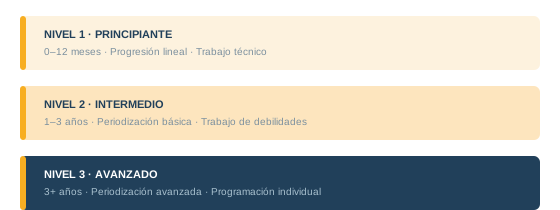
Divide your athletes into three groups based on training age and skill level:
Tier 1 — Beginner (0–12 months of structured training)
- Need a lot of technical work and foundational movement patterns
- Adapt very well to moderate volume with linear progression
- Don’t need complex periodisation: simple load progression is sufficient
- Most vulnerable to overload — always start conservatively
Tier 2 — Intermediate (1–3 years)
- Have developed the basic movement patterns
- Can tolerate more volume and variety
- Beginning to need more sophisticated periodisation
- Benefit from targeted weakness work
Tier 3 — Advanced (3+ years, or with competitive goals)
- Need structured periodisation to continue progressing
- Can tolerate high volume and intensity if recovery is managed
- Require very specific work on their individual limiters
- Benefit most from fully individual programming
With this model, you don’t need to create 30 separate programmes: you have 3 base programmes, each with individual variations where needed. This is entirely manageable and already represents a far higher level of personalisation than most coaches offer.
Individual modifications on top of the tier base
On each base programme, you can add layers of individual personalisation:
- Exercise substitutions based on injury history or mobility limitations
- Volume adjustments (+/– 20–30% based on individual recovery capacity)
- Progressions or regressions for technically complex movements
- Athlete-specific goals (e.g. more Olympic lifting work for someone preparing for competition)
To take this approach even further, there are specific strategies for optimising your CrossFit box programming that complement a level-based approach particularly well.
The step-by-step process for creating a personalised plan
Enough theory. Here’s how it works in practice.
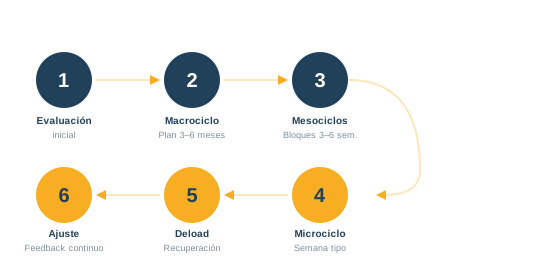
Step 1: Initial assessment
Before writing a single set, you need information. For every new athlete:
- Training history: How long have they been training? What have they done before?
- Injury history: What needs to be accounted for or avoided?
- Goals: What do they want to achieve? In what timeframe?
- Availability: How many days can they train? Do they have capacity for additional work outside the box?
- Movement screening: How are their fundamental patterns? (squat, deadlift, press, pull)
- Capacity tests: 1RM or 3RM on key lifts, or metabolic tests where relevant
This information is the foundation of everything. Without it, you’re programming blind.
Step 2: Define the macrocycle
The macrocycle is the long-term plan, typically 3 to 6 months. The key question is: what do you want this athlete to have achieved by the end of this period?
For a performance athlete preparing for a competition in 16 weeks, the macrocycle is structured around peaking for that event. For someone training for general health, the macrocycle is often less defined, focusing instead on steady progress and long-term consistency. If you coach a mix of athletes across these two profiles, it’s worth exploring how to design a hybrid training programme for your members.
Step 3: Divide into mesocycles
The mesocycle is a 3–6 week block within the macrocycle, with a specific objective. For example:
- Weeks 1–4: Accumulation. High volume, moderate intensity. The goal is to build a base.
- Weeks 5–8: Intensification. Volume drops, intensity rises. The goal is converting volume into strength or performance.
- Weeks 9–12: Peak. Low volume, very high intensity. The goal is expressing maximum performance.
- Week 13: Deload. Reduced volume and intensity. The goal is recovery and consolidation.
This model is for performance athletes. For general health athletes, mesocycles are simpler: perhaps just a load progression over four weeks, then a deload.
Step 4: Plan the weekly microcycle
The microcycle is the training week. This is where the decisions take shape:
- Which days is the athlete training?
- Which patterns are worked each day?
- How is volume distributed across the week?
- Are there high-intensity days and active recovery days?
One important rule: don’t schedule two consecutive high-intensity days unless the athlete has the recovery capacity to handle them. To see what a well-structured training week looks like in a functional fitness setting, this guide to weekly programming breaks it down session by session.
Step 5: The deload week
Deloads are not optional. They’re the week when volume drops to 40–60% of normal and intensity is also reduced. Their function is to allow the body to absorb the adaptations from the previous block, and to begin the next one fresh.
Many athletes — and coaches — see the deload as a wasted week. It’s the opposite: without deloads, fatigue accumulates until performance drops or injury appears.
Deload frequency depends on level: for beginners, every 4–6 weeks is usually sufficient. For advanced athletes in high-volume periods, it may be needed every 3 weeks.
Step 6: Collect feedback and adjust
A personalised plan is not a static document you write once. It’s a living system fed by the athlete’s real response.
After every session, you need to know:
- Did they complete the session as planned?
- How did they feel? (RPE, energy, motivation)
- Was there any unusual pain or discomfort?
Collecting this feedback in a structured way requires athletes to have access to their training programme on their mobile and an easy way to log their results and responses. Moving from a whiteboard to online programming completely transforms the quality of the information you receive.
Common mistakes in personalised programming
Having understood how to do it well, it’s worth knowing the mistakes that come up most often.
Overcomplicating things from the start. Some coaches try to apply block periodisation with daily undulation for an athlete with three months of experience. That athlete doesn’t need it: they need to repeat the fundamental movement patterns, progress load week by week, and sleep well. Complexity has to be justified by the athlete’s level.
Skipping deloads. Already mentioned, but worth repeating: recovery isn’t a weakness — it’s part of training. A programme without planned deloads is incomplete.
Ignoring feedback. The plan you design is a hypothesis. The athlete’s feedback is the experimental result. If you’re not using that information to adjust, you’re ignoring the most valuable data you have.
Personalising too early. Before you individualise, the athlete needs to demonstrate they can be consistent with a standard programme. High-level personalisation requires the athlete to have enough body awareness to give you useful feedback and enough technical foundation to execute movements correctly.
Not documenting anything. Without records, there’s no progression. If you don’t know what an athlete lifted six weeks ago, you can’t know whether they’ve improved.
How to scale personalisation: from spreadsheet to a real system
Everything we’ve discussed so far is methodology. But there’s a practical problem that any coach with more than 10 athletes knows well: how do you actually manage all of this without it becoming unworkable?
Most coaches start with spreadsheets. And they work: you can structure training weeks, record loads and track progress at a basic level. But as your number of athletes grows, spreadsheets begin to show their limitations (and before you reach that point, it’s worth understanding the most common mistakes coaches make when planning training with Excel):
- They’re not designed to assign programmes to specific people
- Athletes can’t access their plan directly on their phone
- There’s no way to collect structured feedback
- Seeing the status of all your athletes at once is practically impossible
- There’s no system for managing what equipment each class needs
The problem isn’t the spreadsheet itself; it’s that it’s designed to manage data, not training programmes and people. If you’re considering alternatives before making the switch, this guide to what training software is and how to choose the right solution for your gym will help you understand which criteria really matter.
What you need as things scale is a tool that understands the logic of training: that Tuesday and Thursday aren’t interchangeable, that assigning a programme to a class and to an individual athlete are different operations, that lets you see at a glance how all your athletes are responding without opening 20 tabs.
Trhade: the tool to take your personalised programming to the next level
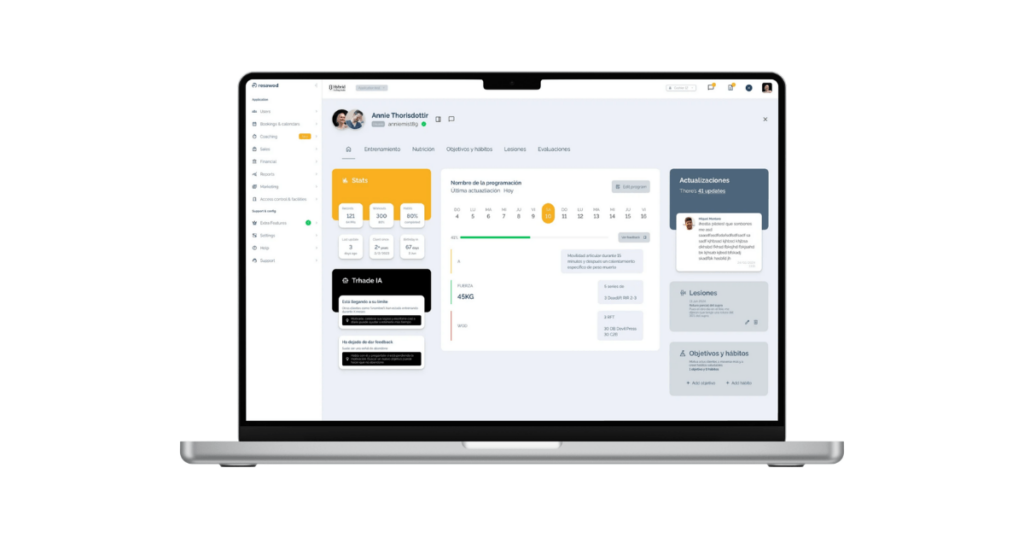
Trhade is Resawod’s workout planning module, built specifically for coaches who need to programme with rigour and genuinely track their athletes. If everything we’ve described in this guide — periodisation, tiers, feedback, continuous adjustment — is what you want to implement, Trhade is the infrastructure that makes it sustainable.
The Designer: build your programming in minutes
The Designer is a visual editor where you build your weeks by dragging workouts to the relevant days. You can duplicate blocks or entire weeks, which means when you have a mesocycle that works well for your Tier 2 athletes, you’re not rebuilding it from scratch — you duplicate it, adjust it, and publish.
Before publishing, the Designer shows you muscle load and movement pattern statistics for the entire block. Now that you understand what balance between push and pull means, or what happens if you overload the lower body two days running, this feature makes complete sense: it’s automatic validation of what you’ve just designed.
Training: assign with precision
Once the programme is ready, you can assign it to a full class, a specific subgroup (your Tier 3 athletes, for instance) or an individual athlete. This makes the tiered model we described fully operational: one base programme per tier, with individual variations where you need them.
The module also includes equipment booking. If you have two classes running at the same time and both require the same Olympic barbells, the system detects the conflict before you arrive at the gym and discover it on the spot. To see how this works specifically in the context of Hyrox and functional training, take a look at how Trhade helps plan training for functional fitness and Hyrox gyms.
Habits: the contextual layer that makes better diagnoses
Remember Step 6 of the process: collect feedback and adjust. The Habits module lets athletes log variables outside the box — sleep, nutrition, stress levels, mobility work — and you see that data alongside their in-session performance.
When an athlete hasn’t improved in two weeks, this context completely changes the diagnosis. The programme being too demanding is a completely different problem to the athlete sleeping five hours a night because of work. The decisions you make are entirely different in each case.
The library: 500+ categorised exercises
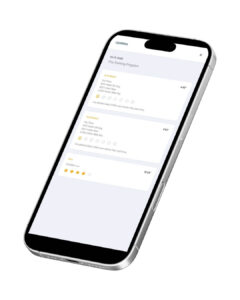
Trhade includes a library of over 500 exercises categorised by movement pattern, muscle group and difficulty level, with technique reference videos. When you’re building exercise selection for each tier and need to find the right variations for individual athletes, all that information is available without leaving the platform. And if your methodology includes movements you’ve developed yourself, you add them once and they’re available for all your future programming.
Personalised workout planning isn’t a luxury or an unnecessary complication. It’s the difference between a coach who manages athletes and a coach who genuinely develops the people they work with.
The process we’ve described — assessment, periodisation, tiers, feedback, adjustment — doesn’t need to be perfect on day one. Start by introducing initial assessments with new athletes. Start by dividing your group into two tiers instead of one. Start by planning a proper deload week once a month.
Every small step in the right direction produces better results than uniform training for everyone.
And when your system grows enough to need infrastructure that supports it, Trhade will be there. If you want to see it in action, book a free demo and we’ll show you how it fits the way you work.
Conclusión
La planificación de entrenamientos personalizada no es un lujo ni una complicación innecesaria. Es la diferencia entre un entrenador que gestiona atletas y un entrenador que transforma a las personas que entrena.
El proceso que hemos descrito —evaluación, periodización, niveles, feedback, ajuste— no requiere ser perfecto desde el primer día. Empieza por introducir evaluaciones iniciales con tus nuevos atletas. Empieza por dividir tu grupo en dos niveles en vez de uno. Empieza por hacer una semana de deload planificada cada mes.
Cada pequeño paso en la dirección correcta produce resultados mejores que el entrenamiento uniforme para todos.
Y cuando el sistema crezca lo suficiente como para necesitar una infraestructura que lo soporte, ahí estará Trhade. Si quieres verlo en acción, solicita una demo gratuita y te lo mostramos adaptado a tu forma de trabajar.
Frequently asked questions
When does it make sense to start personalising? From your very first athlete. You don’t need 50 people to do it — an initial assessment, understanding their goals and injury history, is basic personalisation you can do with any number of athletes.
Is it possible to personalise if I run group classes? Yes. The tier model within group training is effective personalisation. You don’t need to run individual sessions to programme in a differentiated way.
How long does it take to design a personalised programme for multiple athletes? It depends on your system. With a well-structured process and the right tool, programming a week for several groups can take 1–2 hours instead of an entire afternoon.
How often should an athlete’s plan be updated? The plan review should coincide with the end of each mesocycle (every 4–6 weeks). Minor adjustments — based on weekly feedback — are continuous.
Does Trhade work only for CrossFit or for other methodologies too? For any methodology. Trhade doesn’t impose any training model — it adapts to how you work.